Key Takeaways
-
AI is putting pressure on entry-level jobs, without eliminating them. According to a 2026 study by Anthropic, workers aged 22–25 in AI-intensive fields have seen their hiring prospects fall by 14% since ChatGPT was launched.
-
Finance and business jobs are highly exposed to AI: while 94% of tasks could theoretically be automated, only 28% are currently affected in practice. But that gap is narrowing fast, and it may be the most important trend shaping the future of professional services.
-
The Big Four accounting firms cut graduate hiring by 6–29% in just two years. KPMG went from hiring 1,399 UK graduates to 942, a 29% drop. Deloitte cut 18%, EY 11%, PwC 6%. Meanwhile, EY's AI now handles over 3 million compliance checks a year.
-
AI helps weak workers catch up, which sounds good until you realise it kills the reason firms used to train juniors. According to a Harvard study of 758 Boston Consulting Group workers, the weakest got 43% better with AI. The best only improved 17%. The gap that made junior training worthwhile is disappearing.
-
Workers with AI skills earn 56% more than those without. Based on nearly a billion job postings worldwide, PwC found that this AI pay premium doubled in just one year.
-
The US–China AI race makes slowing down impossible. The US poured $109 billion into AI in 2024. China's DeepSeek model jumped Chinese AI from 3% to 13% of global market share in two months.
-
Junior training hasn't disappeared: it's moved. The best places to learn are now boutique firms, in-house jobs, and specialist practices. Not the big names that automated their own training programmes.
The Question
In 2025, McKinsey deployed an AI tool called Lilli to everyone in the company. Within a year, 75% of its 43,000 workers were using it every month. Lilli writes proposals, it pulls together research, and it builds PowerPoint decks from scratch.
McKinsey's global AI lead said it plainly: “Do we need armies of business analysts making slides? No.”
At the same time, KPMG announced its UK graduate intake had dropped 29% in two years. Goldman Sachs reported investment banking fees up 42%, while cutting over 1,000 jobs. Revenue per Goldman Sachs employee hit $2.7 million.
These aren't three separate stories. They're the same story, told from three different offices.
The question financial students might be asking now is simple: will there be a job for me when I graduate? The honest answer is probably yes. But the path has changed. And not everyone has noticed yet.
This article explains what's happening, what the evidence actually shows, and where the real opportunities are.
I. Why It Can't Stop: The Geopolitical Race
To understand what's happening to graduate jobs, you need to understand why nobody can slow this down.
The IMF (International Monetary Fund) says AI will add about 0.5% to global GDP every year through 2030. Goldman Sachs thinks it will boost US worker productivity by 1.5% a year. PwC estimates it'll add $15.7 trillion to the global economy by 2030.
Every government that understands those numbers has reached the same conclusion: whoever wins the AI race wins the economy. There's no off switch.
The United States holds the strongest position right now. It controls about half the world's AI computing power. It has attracted two-thirds of the world's best AI researchers. According to Stanford's 2025 AI Index, private companies in the US invested $109 billion in AI in 2024 alone.
Inside financial services, this is already playing out. Goldman, Morgan Stanley, and JPMorgan are all using AI to do work that used to need junior staff. JPMorgan has told managers directly: don't hire people in areas where AI can do the job.
China took a different path but has the same goal. In January 2025, a Chinese company called DeepSeek released a model that cost a fraction of what US companies spend. According to a RAND Corporation study from January 2026, Chinese AI models jumped from 3% to 13% of global market share in just two months. Chinese models cost one-sixth of American ones. They're now used in over 30 countries.
Europe is taking a third route: regulation instead of raw computing power. The EU AI Act went into full force in August 2026. It says any AI used in credit decisions, risk assessment, or insurance pricing is 'high-risk.' These systems need human oversight. They need audit trails. They need documentation explaining how they work. Break the rules and you can be fined up to 7% of your global revenue. According to Gartner, companies will spend $492 million on EU AI compliance in 2026 alone.
For Dutch students entering finance, this creates an opportunity. The AFM and DNB, the Dutch financial watchdogs, are building entire teams to police AI. Regulatory jobs that used to be boring back-office work are becoming some of the most interesting entry points into European finance.
II. The Gap Between Capability and Reality
In March 2026, Anthropic published the best study we have on AI's real impact on jobs. Instead of guessing what AI could do in theory, they measured what it's actually being used for. They looked at millions of conversations people had with their AI assistant, Claude, and matched them to over 900 different job types tracked by the US Labour Department.
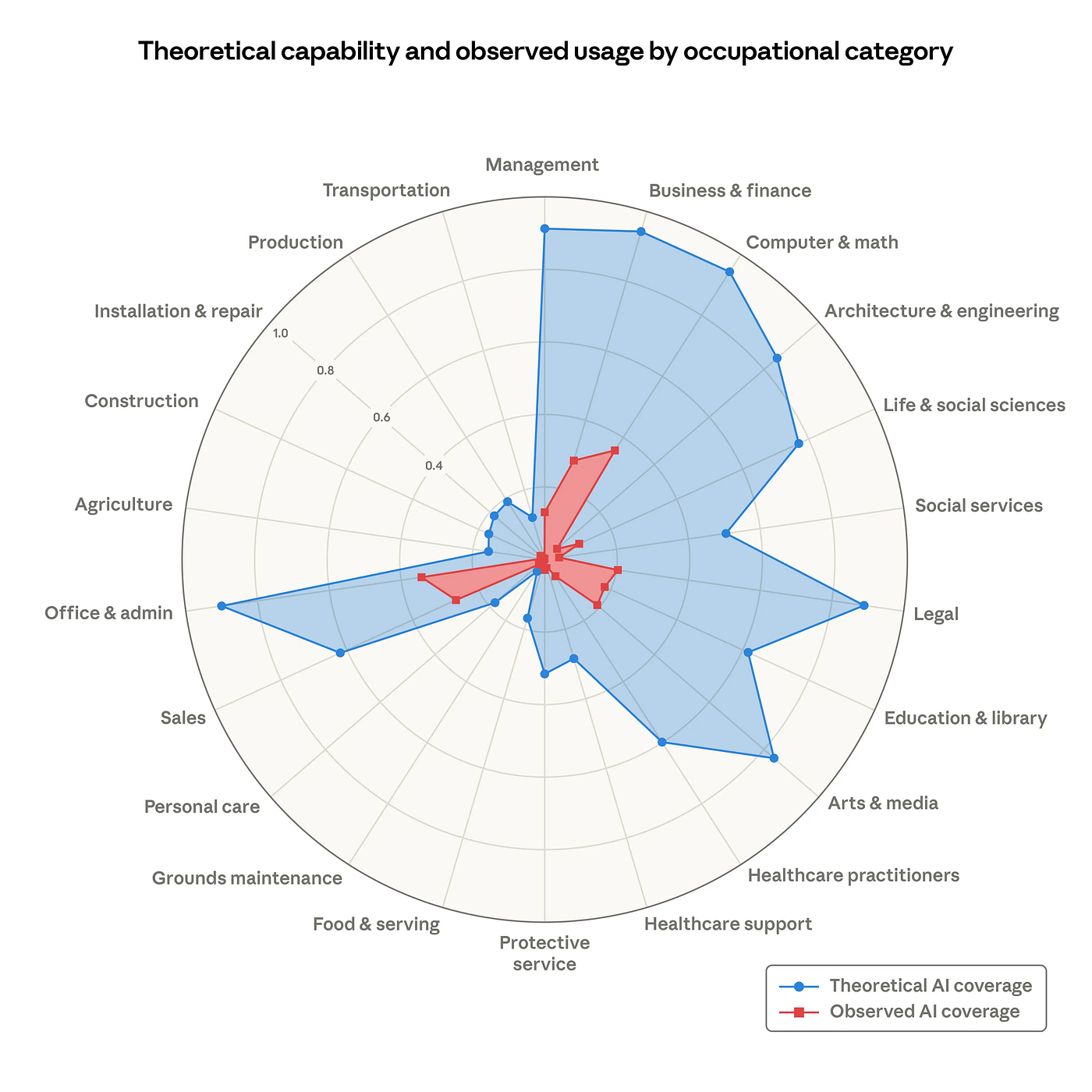
The chart tells the story. Blue shows what AI could do. Red shows what it's actually doing.
For business and finance jobs: AI could theoretically handle 94% of the work. Right now it's handling 28%. For management: 91% possible. For lawyers: 89% possible, only 20% happening. At the other end: grounds maintenance is 4%, physical work in unpredictable places stays human.
“The gap doesn't mean the threat is smaller than it looks. It means the wave hasn't hit yet.”
According to Anthropic, as AI gets better and companies figure out how to use it, the red will grow to match the blue. Closing that gap takes time. You need new workflows. New software. New ways of working. Client trust. But the technology can already do it. The destination is set.
Here's what the employment data actually shows. There's been no big jump in unemployment among people in AI-exposed jobs since ChatGPT launched in late 2022. Mass layoffs haven't happened. But something else has. Workers aged 22 to 25, people graduating now, saw their chances of getting hired drop by 14%. Not layoffs. Just... fewer entry points.
And the workers most at risk aren't who you'd think. According to Anthropic, they're 16% more likely to be women. They earn 47% more than average. They're four times more likely to have a degree. The lawyer, the financial analyst, the consultant, the treasurer, the investment advisor. Not the electrician. Not the plumber.
III. What This Means for Finance, Audit, and Consulting
Junior jobs in these fields were never really about the work you produced. They were about what you learned while doing it. The analyst building a financial model at 2am wasn't there to make a spreadsheet. She was learning how assumptions change outcomes. The auditor checking a sample wasn't there to tick a box. He was learning to spot patterns the process would miss. AI can do the output. It can't do the learning.
Finance: More Revenue, Fewer People
In October 2025, Goldman Sachs told staff it would freeze most hiring and cut some jobs. Same quarter: investment banking fees were up 42%. Total revenue climbed 20% to $15.18 billion.
Goldman's AI assistant is now used by 46,000 employees. According to the company, it makes people 20% more productive in the areas it covers. Research summaries, document drafts, client onboarding, work that used to need a team of three analysts now needs one analyst and an AI subscription.
Here's the problem nobody's saying out loud. If you thin out the group of analysts who would normally spend two years learning the basics, where do your senior people come from in 2035? Goldman CEO David Solomon says AI makes good people better and the savings will fund highvalue hiring. Maybe. But that doesn't explain what happens to the pipeline below.
Audit: Cutting Now, Short of Partners Later
According to Accountancy Age, KPMG cut its UK graduate intake from 1,399 to 942 between 2022 and 2024. That's 29% fewer new hires. Deloitte cut 18%. EY cut 11%. PwC cut 6%.
Meanwhile, EY's AI handles over 3 million compliance checks every year. Deloitte's AI (built with Nvidia) automates invoice checking and routine compliance. The bottom of the audit pyramid: testing transactions, checking reconciliations and basic compliance, is being automated. The EU AI Act still requires a human to sign off at the top.
According to Alan Paton, a former PwC partner who now runs a Google Cloud consultancy, AI can already do 90% of what auditors do. He thinks half of all audit, tax, and advisory jobs could be automated in three to five years.
The audit partner of 2035 needs to be a junior auditor right now. That group just got cut by up to 29%. The firms are optimising for this quarter's profits. They're quietly breaking the system that creates future partners.
Consulting: The Gap That Made Training Work Is Disappearing
The best evidence we have comes from a Harvard Business School study published in Organisation Science in 2025. Researchers ran a proper scientific experiment with 758 Boston Consulting Group consultants. They gave half of them access to GPT-4. The other half worked normally.
The AI group finished 12% more work. They worked 25% faster. Their output was rated 40% better. The weakest consultants improved by 43%. The best consultants only improved by 17%.
That 43% versus 17% gap is the number that matters. AI is a leveller. The difference between a first-year analyst and a third-year associate, the gap that used to justify spending years training people, is shrinking fast.
The study found something else worth noting. AI-helped work was better quality on average but much less varied. And when people used AI for tasks it couldn't actually do well, they performed 19% worse than people without AI. They trusted the output. They stopped checking. A profession that stops training people to think, then gives them a tool that fails quietly at the edges, is building invisible risk.
IV. What We Might Be Getting Wrong
Maybe Junior Jobs Change Instead of Disappear
According to PwC's 2025 Global AI Jobs Barometer, which looked at nearly a billion job ads across six continents, jobs in AI-heavy fields actually grew 38% between 2019 and 2024. This happened even as total job postings fell. A Harvard working paper found that AI creates new demand for jobs where humans and AI work together. Anthropic's study shows no overall rise in unemployment.
The honest version of the argument is this: junior roles are changing faster than firms can redesign them. The skills being automated are exactly the ones that used to build expertise. A junior analyst who spends two years approving AI outputs, without ever learning to question them, isn't being trained. She's being processed. The gap between changing and disappearing is real. But the risk is real too.
Maybe Firms Will Figure Out New Ways to Train People
Some already are. Goldman has launched training programmes. The Big Four have AI courses. Deloitte now tells new hires to focus on talking to clients and analysing data, not manually checking ledgers. These are real attempts to solve a real problem.
The question is whether they work. Does learning to use Lilli teach you the same things as thinking through a client problem from scratch? We don't know yet. The evidence doesn't exist. That's important by itself. It means firms are betting on something whose outcome is genuinely uncertain.
Maybe the Gap Between 'Could Do' and 'Actually Doing' Won't Close Fully
Anthropic's paper itself notes that closing the gap between what AI can do (94% for finance jobs) and what it's actually doing (28%) takes more than better technology. You need new workflows. New software. New ways of working. Client trust. In some areas, like audit, legal liability and professional standards create barriers that technology alone can't break through.
It's possible the 94% never becomes 94%. Not because AI can't do it, but because the system won't let it. The timeline is uncertain. The direction isn't.
V. Ride the Wave: Where to Position Yourself
According to PwC's 2025 study, workers with AI skills earned 56% more than those without. That's double the premium from the year before. Jobs needing AI skills grew 7.5% while total job postings fell 11%. The wave is real. Here are five specific roles where it's creating jobs instead of destroying them.
1. AI Governance and Compliance Specialist
The EU AI Act's rules for financial AI kick in fully in August 2026. Every bank, insurer, and asset manager in Europe needs to show they have human oversight of AI decisions. They need audit trails. They need to be able to explain how the AI works. According to Gartner, companies will spend $492 million on this in 2026.
These firms aren't looking for machine learning engineers. They want people who understand financial regulation, MiFID II, DORA, CRR, and how AI actually works inside it. A finance student who spends the next year learning the EU AI Act inside out will enter a market with more demand than supply. In the Netherlands, the AFM and DNB are hiring for exactly these roles right now.
2. Model Risk
Analyst Banks now use AI for fraud detection, credit scoring, trading, money laundering checks, and customer service. Each system needs someone to check it works properly. Test it. Document it. Watch for problems. The EU AI Act makes this legally required for high-risk systems.
Model risk teams at major banks are expanding. The skills needed: understanding numbers, knowing the regulations, being able to spot when AI gets things wrong, are exactly what a finance degree teaches. According to Veritone's Q1 2025 labour market analysis, the median salary for AI risk roles in US financial services hit $156,998. European pay is catching up.
3. AI-Augmented Financial Analyst
The traditional analyst who spends 60% of their time gathering and formatting data is becoming obsolete. The analyst who spends that time checking AI-generated analysis, catching where the model's assumptions break, and explaining the results to clients is becoming essential.
According to PwC's study, finance teams now need 'fewer reconciliation skills and more business advice skills.' The shift from doing the work to judging the work is the defining change in financial analyst roles over the next five years.
4. AI Implementation Consultant
According to McKinsey's 2025 reporting, companies consistently struggle to turn AI pilots into real business results. The technology works. The organisation doesn't know how to use it. This creates demand for people who can bridge the gap between the AI team and the business.
Boutique AI consulting firms are growing faster than any other part of professional services. For a student who wants consulting but worries about junior roles disappearing at big firms, a boutique offers something McKinsey currently can't: real complexity, client responsibility from day one, and direct exposure to the technology reshaping every industry.
5. Quantitative Researcher in AI-Driven Asset Management
Hedge funds are using AI to process earnings calls, regulatory filings, and news faster than any human team can. The hard part is figuring out how to turn that into actual trading strategies, and how to manage the risk. These jobs sit at the intersection of finance knowledge, data skills, and AI understanding. Firms like Two Sigma and Man Group are hiring aggressively. Entry-level roles in the Netherlands now regularly advertise above €80,000.
The Skill That Actually Matters
Across all five roles, the same pattern shows up. The people who'll do well aren't those who know AI best. They're the ones who combine real finance knowledge with enough AI understanding to question it, and the judgement that comes from handling genuinely hard problems.
That third piece, judgement, is what AI can't copy. It's also what the squeeze on junior hiring puts at risk. According to PwC, companies are asking for degrees less often in AI-heavy jobs. What they're paying for instead is proof you can make good calls in situations the AI wasn't trained for. You build that through experience, not credentials.
“The students who'll thrive aren't those who learn the most AI tools. They're the ones who find places that still teach them to think when the tools are wrong.”
Look for environments where the work is still genuinely complex. Where you'll make real mistakes and learn from them. Where the client's problem is unclear and the answer isn't obvious. These places are harder to find than they were five years ago. They still exist. They've moved to smaller firms, specialist practices, in-house teams. Find them early.
VI. Limitations
Everything in this article reflects what we knew in April 2026. AI is moving fast. What's true now might not be true in six months. If you're reading this later, check whether the key numbers still hold.
This article relies on public data: company reports, academic studies, and regulatory filings. It can't see what's happening inside firms. Many companies are trying new training programmes or new ways of working that aren't visible yet. The apprenticeship model might be changing in ways we can't measure from the outside.
Most data comes from the US and UK. The Dutch market gets less coverage. The three sectors we looked at (finance, audit, consulting) are just part of the picture. What's true here might not apply to law, medicine, or engineering, where the rules and relationships work differently. We don't know yet whether firms will figure out new ways to train people that work as well as the old system.
The sources vary in quality. The Harvard and Anthropic studies are peer-reviewed research. The EU AI Act is law. For example, the AI 2027 scenario video is a thought experiment, not evidence.
Here's what the employment data actually shows. According to Anthropic, the overall unemployment rate for people in AI-exposed jobs hasn't risen since ChatGPT launched in late 2022. But that doesn't mean layoffs haven't happened. Amazon cut 71,000 corporate jobs between 2022 and 2026, with CEO Andy Jassy explicitly citing AI-driven efficiency. Meta, Google, and Microsoft made similar cuts. These displaced workers appear to be finding new roles quickly enough that the occupation-level unemployment rate stays steady. But something else is happening to younger workers. People aged 22 to 25, those graduating now, saw their chances of getting hired drop by 14%. The entry points are narrowing even as total employment holds steady.
Conclusion
Will you get a job? Probably yes. But the path has changed, and the window to position yourself right is shorter than most students realise.
The evidence doesn't support mass unemployment. It supports something more specific. The Big Four cut graduate hiring by 6% to 29%. Goldman grew revenue at record rates while cutting headcount. McKinsey's AI now does what first-year analysts used to do. Workers aged 22 to 25 saw their hiring chances drop 14%.
This isn't jobs disappearing. It's the entry point getting squeezed. The system that used to turn graduates into senior professionals is being eroded at the bottom. The work can be automated. The learning can't.
The big-name firms automated their own training programmes. The better places to learn are now smaller: boutique advisory firms, in-house finance teams, mid-sized audit practices, AI consulting shops, quantitative research teams. The apprenticeship moved. You should too.
The wave is real. Ride it deliberately.
References
- Dell'Acqua, F. et al. (2025). 'Navigating the Jagged Technological Frontier.' Organisation Science. Harvard Business School Working Paper 24-013.
- Acemoglu, D. (2025). Cited in: IMF Working Paper WP/25/76, 'The Global Impact of AI: Mind the Gap.' International Monetary Fund.
- IMF Working Paper WP/25/67 (April 2025). 'Artificial Intelligence and Productivity in Europe.' International Monetary Fund.
- Bostrom, N. (2003). 'Are You Living in a Computer Simulation?' Philosophical Quarterly, 53(211), 243–255.
- Anthropic (March 2026). 'Labour Market Impacts of AI: A New Measure and Early Evidence.' anthropic.com/research/labor-market-impacts
- PwC (June 2025). '2025 Global AI Jobs Barometer.' pwc.com
- Regulation (EU) 2024/1689 — EU AI Act. Official Journal of the European Union, 13 June 2024.
- ESMA Statement ESMA35-335435667-5924 (May 2024). 'AI in Investment Services.' European Securities and Markets Authority.
- Goldman Sachs Q3 2025 earnings release; internal 'OneGS 3.0' memo, October 2025. Reported by Bloomberg.
- Accountancy Age (June 2025). 'The Big Four's New Favourite Grad Is AI.'
- McKinsey & Company (June 2025). 'Rewiring the Way McKinsey Works with Lilli.' mckinsey.com
- Stanford HAI (2025). AI Index Report 2025.
- RAND Corporation (January 2026). 'U.S.-China Competition for AI Markets.' Report RRA4355-1.
- Morgan Stanley Wealth Management (2025). 'Investing in U.S. vs China AI.'
- Gartner (February 2026). AI governance market spending report.
- Veritone / Aspen Tech Labs (Q1 2025). AI Jobs Labor Market Analysis.
- World Economic Forum (2025). Future of Jobs Report 2025.
- Goldman Sachs Research (2025). 'How Will AI Affect the Global Workforce?'
- Fortune (March 2026). 'Anthropic Just Mapped Out Which Jobs AI Could Potentially Replace.' FSG JOURNAL | Financial Study Association Groningen | April 2026 Will I Still Get a Job? | fsgjournal.nl
- IMF / WEF (May 2025). GDP growth projections related to AI adoption.
- Yampolskiy, R. (4 September 2025). 'These Are the Only 5 Jobs That Will Remain in 2030.' The Diary of a CEO with Steven Bartlett.
- Kokotajlo, D. et al. (2025). AI 2027 Report. Video: 'We're Not Ready for Superintelligence.' YouTube.
- Toner, H. (2025). Quoted in AI 2027 video. Former board member, OpenAI.