Key Takeaways:
- FIFA projects the 2026 FIFA World Cup will generate around 40.9 billion USD in global GDP impact and create more than 823,000 jobs worldwide, with approximately 17.2 billion USD in GDP expected to be generated in the U.S. alone.
- More than half of all projected tournament-related spending (54%) is expected to come from tourism, making international visitor demand a crucial assumption behind FIFA’s economic forecasts.
- Host cities are expected to absorb hundreds of millions of dollars in costs related to security, transportation, stadium modifications and fan festivals, while FIFA itself is projected to generate approximately 11 billion USD in profits from the tournament.
- Several economists and former organizers argue that FIFA’s economic projections are overstated and that many studies surrounding mega sporting events function more as promotional tools than independent economic research.
- Historical academic research on previous World Cups suggests that the long-term macroeconomic benefits for host nations are often limited or statistically insignificant once temporary tourism and construction effects disappear.
- Rising visa fees, stricter immigration measures and growing political controversy surrounding U.S. policies may weaken international tourist demand, despite FIFA’s projections heavily depending on foreign visitor spending.
- The economic structure of the World Cup increasingly raises questions about who benefits most from hosting: local taxpayers and governments often bear substantial financial risks, while FIFA captures most direct commercial revenues through broadcasting rights, sponsorships and ticketing.
- Despite these financial concerns, countries and cities continue to compete for hosting rights because the World Cup functions not only as an economic event, but also as a geopolitical project capable of increasing global prestige.
The greatest event the world has ever seen?
Gianni Infantino, the president of FIFA and the ‘king of soccer’ according to President Trump, announced in the Oval Office 1 year ago that the upcoming FIFA World Cup this summer will have an economic impact of more than 40 billion USD in global GDP and will create 200,000 new jobs in the United States. It will be the greatest event the world has ever seen according to Infantino¹. But is this really true? Countries such as Brazil and South Africa were also presented as once-in-a-generation economic opportunities, promising growth. Yet how much of that promised growth actually remained in the host countries after the final whistle? And perhaps more importantly: who ultimately profits most from these tournaments; local
businesses and citizens, or the big organisations such as FIFA? As governments continue to justify massive public spending on stadiums, infrastructure and security, the question remains whether hosting a World Cup should primarily be seen as an economic investment, or maybe as a political project designed to increase global influence and national image.
How the “United Bid” Won the World Cup
The road towards hosting the 2026 FIFA World Cup started years before President Trump and Gianni Infantino stood together in the Oval Office. In order to host a World Cup, countries must first submit a bid to FIFA. For the 2026 tournament, the United States, Canada and Mexico decided to place a joint bid called “United 2026”. Their proposal eventually defeated Morocco’s bid by 134 votes to 65 during the FIFA Congress vote, in which all FIFA member associations were allowed to cast a vote². This winning bid is expected to generate more than 14 billion USD in revenue and 11 billion USD in profits for the FIFA organisation. This profit will be shared with the FIFA member associations³.
Next to the appealing profits for FIFA, The United States, Canada and Mexico were seen as the favourites to host the tournament because of its modern stadiums and existing infrastructure, making the jump from planning to reality relatively small compared to many other countries.
There are also other motivations behind hosting such a global sporting event. For countries like Qatar, hosting a World Cup was part of a broader political strategy to increase international prestige and global influence. For the U.S., however, the motivation appears different. According to former U.S. Soccer Federation president Sunil Gulati, U.S. Soccer mainly sees the tournament as an opportunity to further grow football in a country where sports such as American football, basketball and baseball still dominate. The 1994 World Cup in the U.S. helped lay the foundation for Major League Soccer, and organisers hope the 2026 edition can once again increase interest in the sport, create new fans and further develop football culture in North America⁴.
The decision to host a "United Bid" stems from the sheer scale of the 2026 tournament, which will be the first in history to feature an expanded format of 48 teams and 80 matches. The organizers recognized that this massive undertaking requires the combined resources and capacity of three host countries, stating clearly that none of them could successfully execute an event of this magnitude alone⁵.
The Projected Economic Impact of World Cup 2026
While FIFA and the host nations clearly expect the tournament to be a sporting spectacle, the 2026 World Cup is also being presented as a major economic opportunity. According to FIFA’s own socioeconomic impact analysis, the tournament is expected to generate around 40.9 billion USD in global GDP and create more than 823,000 full-time equivalent jobs worldwide. Of this total economic impact, approximately 17.2 billion USD in GDP and 185,000 jobs are expected to be generated in the U.S. alone.
Much of FIFA’s projected economic impact is based on tourism and consumer spending during the tournament. According to FIFA’s socioeconomic impact analysis, the 2026 World Cup is expected to generate approximately 13.9 billion USD in direct event-related expenditure across the three host countries. This figure represents the total amount of money expected to be spent in relation to the tournament itself, rather than the eventual GDP impact:
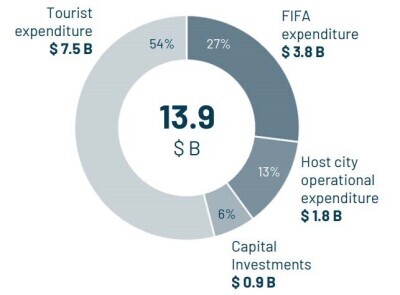
As shown in the figure above, more than half of this spending (around 7.5 billion USD, or 54% of the total) is expected to come from tourist expenditure alone. FIFA’s own operational spending accounts for another 3.8 billion USD, while host city operational costs and capital investments make up 1.8 billion USD and 0.9 billion USD respectively. FIFA estimates that more than 6.5 million spectators will attend matches during the tournament.
The figure below presents something different; not direct spending itself, but FIFA’s estimated contribution to the U.S. GDP. FIFA estimates that the tournament will ultimately generate around 17.2 billion USD in additional GDP for the U.S. economy:
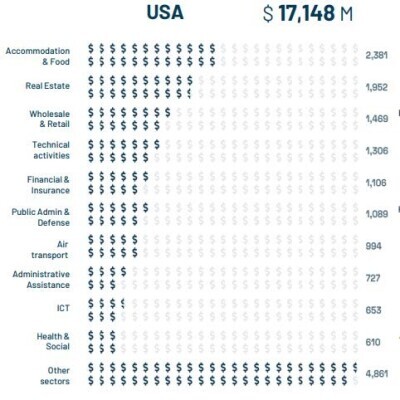
According to the analysis, the accommodation and food sector would benefit the most, with an estimated 2.4 billion USD in additional GDP contribution. Real estate follows with approximately 1.95 billion USD, while wholesale and retail is projected to gain around 1.5 billion USD.
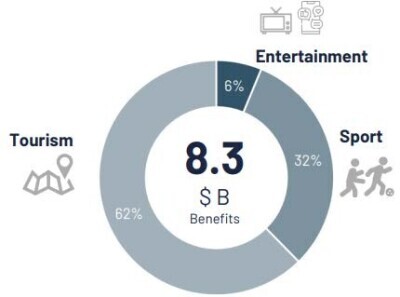
FIFA’s projections do not stop at GDP growth and tourism revenues alone. The organization also claims that the tournament will create substantial long-term social and societal benefits beyond the direct economic impact of the event itself. FIFA argues that hosting the competition will increase the global visibility of cities, potentially strengthening tourism in the years after the event. The report additionally highlights several so-called “social benefits,” including increased sports participation, improvements in public health through physical activity, stronger community engagement and even reductions in crime rates linked to greater involvement in sports. According to the study, the tournament could generate around 8.3 billion USD in broader social benefits globally over a five-year period ⁶.
The Other Side of the Economic Story
However, these optimistic projections are increasingly being questioned by economists, local officials and even former World Cup organizers themselves. While FIFA’s reports focus heavily on projected GDP growth, tourism spending and job creation, critics argue that the financial burden of hosting the tournament falls disproportionately on local governments and taxpayers. Cities such as Houston and Dallas, together with the other American host cities, have agreed to cover hundreds of millions of dollars in costs related to security, stadium modifications, transportation and fan festivals, while FIFA itself is expected to generate approximately 11 billion USD in profits from the tournament.
What makes this arrangement particularly controversial is that host cities receive relatively little direct revenue in return. According to reports on the host city agreements, local governments do not receive a share of ticket sales, merchandise revenue or parking income during matches. Even opportunities to generate revenue through corporate sponsorships were heavily restricted by FIFA. Alan Rothenberg, former president of U.S. Soccer and one of the organizers of the 1994 World Cup, described the agreements as “very, very one-sided,” arguing that previous World Cups allowed host cities to benefit far more directly from tournament revenues.
The growing criticism surrounding the 2026 World Cup highlights a broader economic debate about mega sporting events: who actually benefits from hosting them? While sectors such as hotels, bars and restaurants may experience temporary increases in revenue, economists point out that this does not necessarily translate into meaningful gains for city budgets or taxpayers. Former Houston finance director Kelly Dowe even stated that cities are often simply “glad to break even.” Houston alone is expected to receive 65 million USD in federal funding to help cover security costs, part of a broader 625 million USD public investment by American taxpayers into the tournament.
The financial pressure is already becoming visible in some host regions. In New Jersey, roundtrip train fares from New York City to MetLife Stadium (which will host the World Cup final on July 19) were raised from the normal $12.90 to around $150. Officials argued that without these increases, transportation providers would lose millions of dollars due to the additional trains, staffing and security measures required during the tournament ⁷.
At the same time, FIFA projects that the Club World Cup (which took place in the U.S. last year) and the ‘normal’ World Cup will together generate around 47 billion USD in economic impact across the country⁸. Supporters of public financing argue that the exposure and tourism generated by the event justify these investments. However, several economists strongly question these figures. Victor Matheson, a sports economist at the College of the Holy Cross, called FIFA’s projections “insanity,” arguing that the calculations imply every single match would generate around 400 million USD in economic activity, or roughly 5,000 to 7,000 USD per fan attending. According to Matheson, many of these studies function more as promotional material than independent economic research.
Critics also argue that much of the projected economic activity does not represent genuinely new spending. Local residents attending matches would likely have spent their money elsewhere in the city anyway, while other events and conferences may actually avoid host cities during the tournament period.
Another major criticism concerns the lack of transparency surrounding the agreements between FIFA and host cities. Many contracts remain confidential, while several financial details (including how much FIFA pays to rent stadiums or what tax advantages the organization receives) have been redacted from public documents. As a result, taxpayers often remain unclear about how much public money is ultimately being invested into the tournament and whether the promised economic returns will ever fully materialize. This creates an important contrast with FIFA’s public messaging, which consistently presents the World Cup as a large-scale economic success story for host nations⁹.
The Demand-Side Risk of World Cup 2026
Another potential threat to the projected economic success of the tournament is weakening international tourist demand. As said before, a significant share of the expected economic impact is based on foreign visitors spending money. 54% of all expenditures related to the World Cup are expected to come from tourists. However, several recent policy changes and rising travel costs in the U.S. may create substantial obstacles for international fans wanting to attend the tournament.
The Trump administration has introduced stricter immigration measures and higher travel costs for foreign visitors. The price of the Electronic System for Travel Authorization (ESTA) for many European travelers has almost doubled from $21 to $40, while tourist visa fees for visitors from countries not eligible for ESTA increased from $160 to $185. In addition, a proposed $250 “visa integrity fee” could push the total cost of a tourist visa for countries such as Mexico and Brazil up to $435 per person. Visitors from several African nations participating in the tournament may even face additional visa bonds ranging from $5,000 to $15,000.
Beyond the direct financial barriers, concerns surrounding immigration enforcement and travel restrictions may further discourage fans from attending matches in the U.S. Immigrations and Customs Enforcement (ICE) has previously arrested tourists with valid visas. This may make football fans not want to attend anyway.
These concerns are increasingly spilling over into the political debate surrounding the World Cup itself. In the Netherlands, for example, a petition calling for the Dutch national team to boycott the tournament in the U.S. gathered more than 150,000 signatures. The petition argued that participation in the tournament would amount to implicit support for President Trump’s immigration policies and aggressive foreign policy rhetoric.
There are already mixed signals regarding demand. While short-term rental platform AirDNA reports rising Airbnb bookings and occupancy rates in several host cities, the traditional hotel sector appears less optimistic. Hotel bookings in New York City during the World Cup period were recently reported to be running approximately 2% below levels from the same period last year, despite no comparable mega-event taking place at that time. This raises further questions about whether the enormous tourism projections used in many economic impact studies will ultimately materialize in practice¹⁰.
What Previous World Cups Reveal About Long-Term Economic Impact
Having examined both FIFA’s highly optimistic economic projections and the growing criticism surrounding taxpayer costs, transparency and weakening tourist demand, an important question still remains: what do previous World Cups actually tell us about the real economic impact of hosting such a tournament? While FIFA’s forecasts for 2026 predict tens of billions of dollars in additional GDP and hundreds of thousands of new jobs, historical evidence from earlier tournaments may provide a more reliable indication of whether these promises tend to materialize in practice. This question was examined in a 2018 academic study titled Does the World Cup get the economic ball rolling?, which analyzed the long-term economic effects of previous FIFA World Cups on host nations using macroeconomic data and a statistical method known as the “synthetic control approach.”
Rather than relying on FIFA projections or short-term tourism data, the researchers compared host countries to a statistically constructed “synthetic” version of those same economies; essentially an artificial control group made up of similar non-host countries. This allowed them to isolate the actual effect of hosting a World Cup on long-term economic growth. The study examined several previous tournaments, including World Cups hosted by countries such as France, Germany and South Africa, using macroeconomic data on GDP per capita over multiple years before and after the tournaments.
According to the study, many of the positive economic forecasts surrounding mega sporting events suffer from the same structural problem: they focus heavily on short-term spending while ignoring the broader economic context. Large inflows of tourists and temporary investments may create visible economic activity during the tournament itself, but this does not automatically translate into sustainable economic growth after the event ends. In several previous host countries, the long-term macroeconomic effects turned out to be either very limited or statistically insignificant. The general conclusion of the paper points in the direction that hosting a World Cup leads to no economic benefit. This directly challenges one of FIFA’s central arguments for hosting the World Cup: that the tournament acts as an economic accelerator for the host nation¹¹.
World Cup Hosting as Political Strategy
Despite the growing criticism surrounding the financial burden of hosting the World Cup, cities did compete for the opportunity to stage matches. One reason is that the perceived benefits of hosting a mega sporting event often extend beyond direct financial returns. City governments and local organizers frequently point to intangible advantages such as international exposure and civic pride. Even though these benefits are difficult to quantify economically, hosting the World Cup places cities at the center of one of the most watched events on the planet, potentially strengthening their global image for years after the tournament ends.
There is also a strong competitive dynamic between cities themselves. Local governments fear missing out on the economic activity, tourism and international attention associated with the tournament, especially when rival cities are willing to accept FIFA’s demands. This creates a situation in which FIFA is able to negotiate increasingly one-sided agreements, knowing that cities remain eager to participate despite the financial risks involved. The result is effectively a “race to the bottom,” where host cities continue accepting large public costs in exchange for uncertain long-term returns⁷.
Political incentives also play an important role. Hosting a World Cup is not just about economics or sport; historically, the tournament has often functioned as a global showcase for national identity, political ideology and international prestige. From the very beginning, the World Cup has been deeply connected to politics and nation-building.
The first World Cup in 1930 already illustrated this dynamic. Uruguay actively used football to position itself on the international stage during a period in which the country sought greater diplomatic recognition and national unity. After Uruguay won Olympic gold in football in 1924 and 1928, the national team was increasingly viewed as a symbol of modernity and national success. Uruguayan newspapers even claimed that the football team had done more for the country’s international reputation than “thousands of dollars spent on propaganda.” When Uruguay hosted and won the first World Cup in 1930, the tournament coincided with the centenary of the Uruguayan constitution, turning the event into a celebration of national identity and state legitimacy.
Only four years later, Italy demonstrated how the World Cup could also be used far more aggressively as a political instrument. Under Benito Mussolini, the 1934 tournament became a large-scale projection of fascist Italy to the rest of the world. The regime invested heavily in
stadium construction, infrastructure, transportation and propaganda surrounding the event. Hosting the tournament successfully was presented as evidence of Italy’s national strength, efficiency and superiority. Foreign visitors and international media coverage were used to reinforce the image Mussolini wanted to project abroad.
Since then, the World Cup has repeatedly served as more than just a sporting event. From Argentina in 1978 to Russia in 2018 and Qatar in 2022, host nations have consistently used the tournament to strengthen their international image, increase soft power and present themselves as modern, influential and globally relevant states. In that sense, the 2026 World Cup may also be viewed as part of a broader political project for the U.S., Canada and Mexico. Beyond the direct economic calculations, the tournament offers an opportunity to project stability, international influence and cultural relevance to billions of viewers worldwide¹².
Conclusion
The 2026 FIFA World Cup is being presented by FIFA and political leaders as the largest and economically most successful tournament in history. Projections of more than 40 billion USD in global GDP impact, hundreds of thousands of new jobs and billions in tourism spending create the image of a once-in-a-generation economic opportunity. Yet, when looking beyond the headline figures, a far more complex picture emerges.
Throughout this article, two competing narratives surrounding the World Cup became visible. On the one hand, there is FIFA’s vision of the tournament as a major economic catalyst capable of boosting tourism, stimulating local industries and increasing global exposure for host cities and nations. Hotels, restaurants, airlines and entertainment sectors will likely benefit from the influx of visitors, while the tournament may also strengthen football’s long-term growth in North America.
On the other hand, economists, historical research and criticism from former organizers suggest that these benefits are often overstated. Host cities are expected to absorb hundreds of millions of dollars in costs related to security, infrastructure and transportation, while FIFA itself captures most of the direct revenues through broadcasting rights, sponsorships and commercial agreements. Academic research into previous World Cups further suggests that the long-term macroeconomic benefits for host nations are often limited or statistically insignificant once the temporary effects of tourism and construction disappear.
This ultimately brings the discussion back to the central question raised at the beginning of this article: who actually profits most from hosting a World Cup? While certain local sectors may experience short-term gains, the financial structure surrounding the tournament appears to benefit FIFA and its commercial partners disproportionately compared to local taxpayers and governments carrying much of the risk.
At the same time, reducing the World Cup purely to a financial calculation may overlook an important part of why countries continue to compete for hosting rights. As history has shown from Uruguay in 1930 to Qatar in 2022, the World Cup has never been solely about economics. It is also a political and symbolic project; a global stage on which nations attempt to project prestige, modernity and international influence. In that sense, the 2026 World Cup may ultimately say as much about the geopolitical ambitions and global image of the U.S., Canada and Mexico as it does about football itself.
Reference List
1. Diaro AS (2025)
https://www.youtube.com/watch?v=O7R3KIqPfD4
2. BBC (2018)
https://www.bbc.com/sport/football/44464913
3. US Soccer (2018) https://www.ussoccer.com/stories/2018/06/united-bid-selected-to-host-the-2026-fifa-world-cup
4. The Guardian (2015) https://www.theguardian.com/football/blog/2015/aug/10/is-the-us-ready-or-even-willing-to-host-the-2026-world-cup
5. FIFA (2018) https://inside.fifa.com/tournaments/mens/worldcup/canadamexicousa2026/news/2026-fifa-world-cup-bid-books-now-available
6. FIFA (2025) https://inside.fifa.com/organisation/media-releases/fifa-wto-study-estimates-usd-47-billion-economic-output-from-fifa-club-world
7. Forbes (2026) https://www.forbes.com/sites/clementelisi/2026/05/04/the-world-cups-hidden-cost-why-host-cities-pay-more-than-they-gain/
8. FIFA (2025) https://inside.fifa.com/organisation/media-releases/fifa-wto-study-estimates-usd-47-billion-economic-output-from-fifa-club-world
9. ProPublica (2026) https://www.propublica.org/article/world-cup-2026-host-cities-revenue-houston
10. Fortune (2026) https://fortune.com/2026/04/04/world-cup-gianni-infantino-usa-mexico-canada-travel-iran-war-donald-trump-geopolitics-high-gas-prices/
11. Jorge H.N. Viana, Antonio Vinicius Barbosa, Breno Sampaio (2018) https://www.sciencedirect.com/science/article/pii/S151775801530031X
12. The Guardian (2026) https://www.theguardian.com/football/2026/apr/16/the-world-behind-the-cup-nation-building-through-soccer